The Truth About Human Hair Quality
Five dimensions. Not one impressive label.
Understand the five dimensionsSame label. Different hair.

Consider a common salon scenario. Two bundles sit under the same light. Both labels say 100% human hair. Both feel impressive in the hand. A client leaves delighted after installation.
Three washes later — in one illustrative outcome, not a rule for every installation — one set still behaves well while another begins to mat at the nape, dull at the ends, or resist the brush. The client assumes the stylist did something wrong. The stylist assumes the supplier did something worse. Often, neither is entirely fair — because the label never stated what was actually being purchased.
Human hair is not a single quality. It is a material with a history, a direction, a length mix, a processing path and an intended use. Until you read those dimensions separately, you are comparing prices on a word — not on hair.
The industry has trained buyers to listen for the most reassuring adjective. Remy sounds reassuring. Virgin sounds pure. Double Drawn sounds full. 100% human hair sounds like the argument should be over. In reality, each phrase answers a different question — and silence on any one of them can explain an expensive mistake.
This is the truth about human hair quality: it cannot be described by one impressive label.
Answer-first summary
Quality in human hair extensions and systems is assessed through five separate dimensions, not one marketing grade.
Four dimensions classify fibre attributes:
- Chemical history — Virgin or Processed
- Direction and cuticle alignment — Remy or Non-Remy
- Length distribution within 100 grams — Ratio
- Commercial fullness classification — Draw Class (Single Drawn, Double Drawn, Super Double Drawn or Custom)
The fifth dimension is different:
5. Fitness for Purpose / Product Construction
This is not an intrinsic fibre grade. It evaluates whether a given specification suits tape, keratin bond, micro ring, machine weft, topper or hair-system construction — including how the hair was prepared for that format.
A bundle can score well on one fibre attribute and poorly on another — or suit one method and not another. That is why two “100% human hair” products can behave completely differently, and why the most expensive word on the label is not always the most informative.
Five-dimension quality system
Virgin or Processed
What it describes
Virgin raw hair has not undergone chemical colouring, bleaching, perming, highlighting or comparable chemical alteration before entering manufacturing processing. When Virgin raw hair is subsequently lightened, coloured or otherwise chemically altered to produce a finished shade, the finished commercial product is Processed Hair — even if the raw material began Virgin.
What it does not prove
Virgin raw status at intake does not prove Remy alignment, a specific Ratio or Draw Class, origin country, or performance under every maintenance routine. We do not claim that all incoming supplier-labelled Virgin hair is independently verified without our own intake assessment and documentation.
Why the buyer should care
For salon professionals: if you purchase a factory-coloured shade from a manufacturer’s chart, you are installing Processed Hair in the chemical-history sense — even when production began with Virgin raw material. Value depends on how well the hair was processed, not on whether “Virgin” appeared upstream on a supplier invoice.
Industry definition
Remy or Non-Remy
What it describes
Remy and Non-Remy describe root-to-tip direction and cuticle alignment in industry usage. Remy indicates strands arranged consistently in one direction; Non-Remy indicates mixed or inconsistent direction.
What it does not prove
Remy labelling does not prove Virgin or Processed chemical status of the finished product, ethical origin or temple sourcing, a specific Ratio, or that all commercially labelled Remy will perform equally. Do not assume that all Remy hair is acid-treated. Do not assume that all commercially labelled Remy hair is high quality.
Why the buyer should care
In wholesale practice, Remy is sometimes used loosely. A bundle may be marketed as Remy while a meaningful minority of strands runs against the grain — which can increase tangling risk at the nape once heat, friction and product build-up accumulate, depending on method and maintenance.
Industry definition
Ratio
What it describes
Ratio describes the distribution of different strand lengths inside each 100-gram blend. It is a weight-based length mix, not a brand adjective.
What it does not prove
Ratio does not prove Remy status, Virgin/Processed status or origin. It explains fullness and behaviour — especially toward the ends.
Why the buyer should care
Two bundles with the same advertised length can have very different Ratio profiles and very different end fullness. Picture two 100 g wefts at the same advertised length. One feels thicker at the ends because long strands carry the visible weight of the blend. Another looks lighter at the ends even though the packet weighs the same.
Industry definition
Draw Class
What it describes
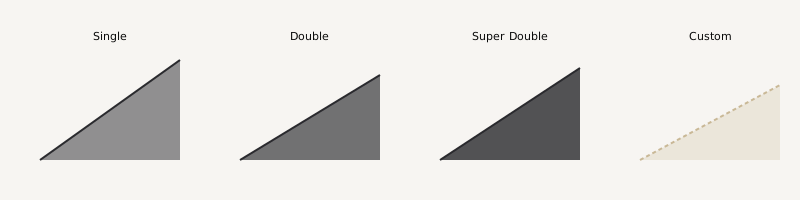
Single Drawn, Double Drawn, Super Double Drawn and Custom are commercial fullness classifications derived from Ratio — not independent scientific grades.
What it does not prove
“Double Drawn,” “Super Double Drawn” and similar terms do not prove a universal fixed percentage unless the seller publishes its actual Ratio specification for that grade. One supplier’s Double Drawn can differ materially from another’s.
Why the buyer should care
When a professional asks for “Double Drawn” without asking what length buckets define the grade, they outsource the specification to an adjective. The intelligent buyer asks for a Ratio profile — or accepts an undefined word.
Industry definition
Fitness for Purpose
What it describes
Fitness for Purpose / Product Construction is not an intrinsic fibre grade. It evaluates whether a given specification suits tape, keratin bond, micro ring, machine weft, topper or hair-system construction — including how the hair was prepared for that format.
What it does not prove
A bundle can score well on one fibre attribute and poorly on another — or suit one method and not another. That is why two “100% human hair” products can behave completely differently.
Why the buyer should care
A Ratio profile that suits tape can disappoint in keratin preparation if the construction, bond type or maintenance routine fights the blend. Quality is not only what the fibre is; it is whether the specification was prepared for what you plan to do with it.
The label problem
Walk any trade fair or scroll any wholesale catalogue and you will meet the same vocabulary: Remy, Virgin, Double Drawn, Premium, Cuticle intact, Top grade. Each word sounds like a guarantee. Together they can sound like perfection.
In trade usage, these terms describe specific attributes when used honestly. They are not interchangeable synonyms for “best hair” and they do not, alone, prove origin or predictable salon performance under every care routine.
“100% human hair” states a material claim. The label alone does not verify processing history, cuticle condition, root-to-tip direction, Ratio inside 100 grams, or how the hair will behave after washing, colouring or daily wear.
The buyer’s task is not to find the loudest label. It is to find the most transparent specification — dimension by dimension.
Professionals learn this in consultation: a client arrives with a listing screenshot, convinced that one word guarantees effortless wear. The consultation becomes translation work — from marketing language to inspectable facts. Hair Intelligence exists to shorten that translation, not to add jargon.
Virgin vs Processed — chemical history
Virgin raw hair has not undergone chemical colouring, bleaching, perming, highlighting or comparable chemical alteration before entering manufacturing processing.
That definition is about documented chemical history at a defined stage, not about how the hair looks in a photograph.
When Virgin raw hair is subsequently lightened, coloured or otherwise chemically altered to produce a finished shade, the finished commercial product is Processed Hair — even if the raw material began Virgin.
Once hair is subjected to strong acid cuticle-removal treatment, bleached, dyed, toned or otherwise chemically altered in manufacturing, the commercial classification moves to Processed Hair for that finished product.
Permanent oxidative hair colour and lightening follow a pathway distinct from strong acid cuticle-removal processing. In broad terms — as described in authoritative hair-science reference works — the alkaline environment swells the fibre and raises the cuticle structure, allowing peroxide and dye intermediates to act within the hair. Peroxide oxidises natural melanin while oxidative dye precursors form colour molecules (Robbins, 2012).¹
That oxidative pathway must be kept separate in public explanation from strong acid treatments used to reduce cuticle friction. Both can yield Processed Hair in commercial classification. They are not the same process to describe, defend or compare without qualification. This article does not provide operational chemical instructions, concentrations or formulas.
We may begin with virgin, full-cuticle raw hair. Once we lighten or colour that hair to create any of our 141 shades, the finished coloured product is processed hair. We do not continue calling it virgin simply because the raw material began that way.
We do not claim that all incoming supplier-labelled Virgin hair is independently verified without our own intake assessment and documentation.
Virgin raw status at intake does not prove Remy alignment, a specific Ratio or Draw Class, origin country, or performance under every maintenance routine.
Step 1
Raw Virgin full-cuticle
Virgin raw hair with full cuticle — documented chemical history at intake, before manufacturing processing.
Step 2
Controlled lightening/colouring
Lightening, colouring or comparable chemical alteration to produce a finished shade within the 141-colour architecture.
Step 3
Finished Processed Hair
The finished commercial product is Processed Hair — even when production began with Virgin raw material.
Step 4
Honest product label
Commercial description must shift to Processed. We do not treat supplier Virgin labels as automatically verified.
141-shade disclosure: We may begin with virgin, full-cuticle raw hair. Once we lighten or colour that hair to create any of our 141 shades, the finished coloured product is processed hair. We do not continue calling it virgin simply because the raw material began that way.
Factory note — Murat Kolukırık
Factory observation / professional experience supplied by Murat Kolukırık.
We regularly receive raw material described as Virgin by suppliers. Our first production question is not the label alone — it is what we will do to it next and how we will describe the finished product. If we colour or lighten to a catalogue shade, our commercial description must shift to Processed. We do not treat supplier Virgin labels as automatically verified.
Remy vs Non-Remy — direction and alignment
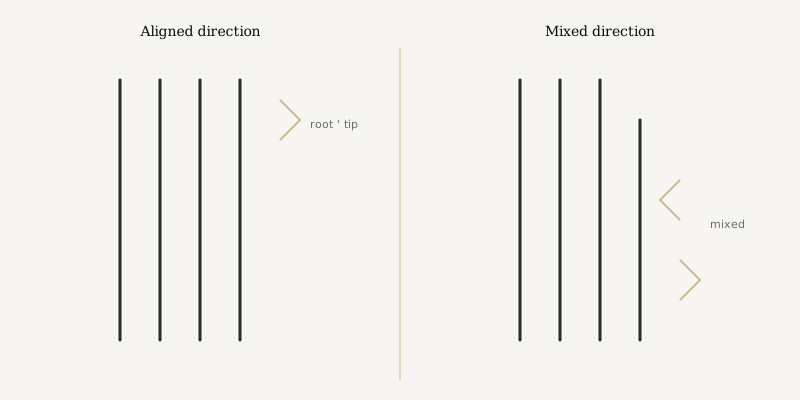
Remy is not a synonym for Virgin. Remy is not a Draw Class. A bundle can be Remy and Processed, or Non-Remy with Virgin raw history at intake — the fibre attributes are independent.
Remy labelling does not prove Virgin or Processed chemical status of the finished product, ethical origin or temple sourcing, a specific Ratio, or that all commercially labelled Remy will perform equally.
Do not assume that all Remy hair is acid-treated. Do not assume that all commercially labelled Remy hair is high quality. The word describes direction, not a universal grade — and it says nothing about how or where the hair was sourced.
What Remy describes
Root-to-tip direction and cuticle alignment. Remy indicates strands arranged consistently in one direction; Non-Remy indicates mixed or inconsistent direction. The word describes direction, not a universal grade.
What Remy does not prove
Virgin or Processed chemical status, ethical origin or temple sourcing, a specific Ratio, or that all commercially labelled Remy will perform equally. Do not assume that all Remy hair is acid-treated or high quality.
Factory note — Murat Kolukırık
Factory observation / professional experience supplied by Murat Kolukırık.
Mixed-direction hair tangles more readily when installed without corrective processing or without a product construction suited to that fibre. Direction is not an abstract trade argument — clients feel the difference at the nape when alignment, method and home care do not match. We do not quote fixed time guarantees.
Cuticle, processing and first-wash behaviour
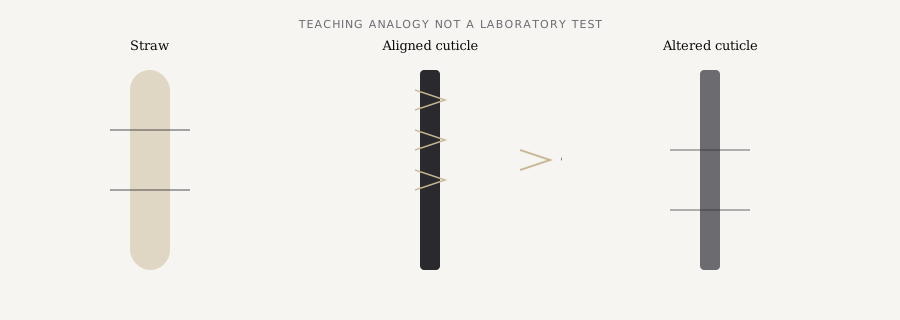
Human hair’s outer cuticle scales lie along the shaft like overlapping tiles. When aligned root-to-tip, the surface feels smoother in one direction. When cuticles are damaged, raised, removed or heavily altered, behaviour changes.
Authoritative hair-science reference works describe the cuticle as the fibre’s outer protective layer; damage or removal affects friction, feel and how the hair accepts chemical services (Robbins, 2012).² This is general fibre science, not a claim about any specific SKU in your hand.
Hair subjected to strong acid treatment that removes or substantially alters the cuticle is classified as Processed Hair for commercial purposes, regardless of earlier Virgin raw history.
Factory note — Murat Kolukırık
Factory observation / professional experience supplied by Murat Kolukırık.
Strong cuticle-removal treatment reduces directional friction — which is why some processed hair feels unusually uniform when new — but it also removes part of the structure that contributes to longer-term handle and service behaviour.
Silicone-based or other cosmetic coatings temporarily make heavily processed hair feel smooth before installation. A bundle can look glossy when new yet behave differently after washing. Coatings alter initial feel but cannot recreate the original biological cuticle structure. Not every smooth-feeling product is coated — appearance and feel alone do not prove coating.
That post-wash moment is not bad luck. It is often the first honest conversation between the client and the fibre.
Silicone-based or other cosmetic coatings are not automatically “bad.” In some trade paths they stabilise feel before installation. The professional question is whether the underlying fibre supports the maintenance plan after superficial finishing residue is reduced. A decision based only on first-open touch is a decision on the opening scene, not the full film.
Evidence available — Cuticle vs cortex — what we can and cannot claim publicly
- Source
- Robbins, C.R. (2012). Chemical and Physical Behavior of Human Hair (5th ed.). Springer-Verlag — cuticle structure and fibre surface properties (Ch. 1).
- Supports
- General fibre science: the cuticle is the outer protective layer; damage or removal affects friction, feel and chemical service behaviour.
- Does not prove
- Cuticle condition, coating use or processing history of any specific bundle in your hand without documented product evidence.
The straw analogy — a teaching picture, not a laboratory test
Hold a drinking straw between your fingers and slide them along it. The surface feels similar in both directions. A cuticle-substantially-removed fibre behaves more like that straw: relatively smooth in either direction, because the directional tile structure is no longer doing the work.
Natural hair with intact, aligned cuticle often feels smoother root-to-tip and rougher or catchier tip-to-root — which is why a preliminary sliding test is sometimes used in trade as a tactile hint only.
The straw comparison is a teaching analogy. It is not laboratory proof of Remy status, Virgin status, origin or processing history.
Factory note — Murat Kolukırık
Factory observation / professional experience supplied by Murat Kolukırık.
The sliding test is a preliminary tactile indication only. Use a clean, dry sample after superficial finishing residue has been reduced through an agreed controlled-wash protocol. Root-to-tip may feel smoother; reverse direction may show resistance — which can reflect aligned cuticle direction, but can also reflect raised, damaged or irregular cuticle. A smooth bidirectional feel can result from cuticle alteration or silicone-based or other cosmetic coatings. The test cannot prove Remy, Virgin, origin or processing history. Microscopy or validated instrumental testing would be required for stronger proof.
Ratio — what sits inside 100 grams
Imagine weighing out exactly 100 g of extension hair and sorting strands into length buckets. The profile of that mix is the Ratio. Two bundles with the same advertised length can have very different Ratio profiles and very different end fullness.
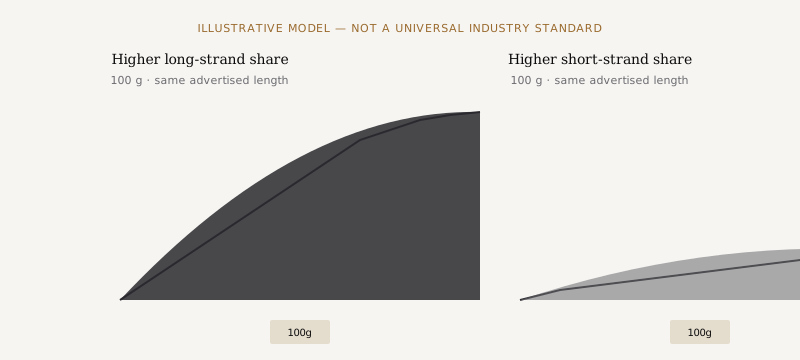
Picture two 100 g wefts at the same advertised length. One feels thicker at the ends because long strands carry the visible weight of the blend. Another looks lighter at the ends even though the packet weighs the same: a higher share of shorter strands falls away before the final inches, leaving the ends visibly lighter while total pack weight stays identical.
Illustrative model — not a universal industry standard.
Illustrative model — not a universal industry ratio. Preset profiles below are teaching aids only. They are not measured production percentages.
Balanced mix — illustrative middle profile. Illustrative model — not a universal industry ratio.
| Bucket | Illustrative emphasis |
|---|---|
| Longer strands | Higher / mid / lower (preset-dependent) |
| Mid-length strands | Higher / mid / lower (preset-dependent) |
| Shorter strands | Higher / mid / lower (preset-dependent) |
Not confidential production workbook data.
Factory note — Murat Kolukırık
Factory observation / professional experience supplied by Murat Kolukırık.
A higher long-strand proportion within 100 g requires additional selection and sorting. Shorter strands removed from one grade may be redirected into shorter products or other production — they are not necessarily discarded as waste. The economic cost remains because total harvested material contains a natural distribution of lengths. A buyer requesting a higher long-strand share is purchasing greater selection, not making shorter supply disappear from the world.
Draw Class — commercial fullness, not universal law
Why price changes — economics, not adjectives
Premium human hair costs more when more of the supply chain performs more work — and when more fibre is rejected or downgraded.
Factors that legitimately move price include:
- Better raw material selection — fewer irreversible defects at intake
- Higher long-strand proportion in the Ratio — more selection and sorting labour
- Careful direction sorting — labour and rejected mixed bundles
- Controlled processing — colour, lightening or corrective work with acceptable yield
- Factory colour work — creating and holding a stable shade within the 141-colour architecture
- Quality control — units or batches rejected before sale
The fifth dimension — Fitness for Purpose / Product Construction — belongs in the same conversation. A Ratio profile that suits tape can disappoint in keratin preparation if the construction, bond type or maintenance routine fights the blend. Quality is not only what the fibre is; it is whether the specification was prepared for what you plan to do with it.
We do not publish supplier prices, internal yield percentages or confidential costing workbooks. Price differences should be explained by transparent specifications where possible — not by mystery labels.
Factory note — Murat Kolukırık
Factory observation / professional experience supplied by Murat Kolukırık.
When a client asks only “Is it Remy?” without asking about chemical status, Ratio, Draw Class and intended method, the comparison is not yet fair — to the client, the stylist or the hair.
Buyer inspection framework — ask before you buy
Do not infer origin, Virgin status, Remy status, coating use or processing history from appearance alone.
A useful habit: photograph or video the sample after a controlled wash when evaluating a new supplier. Document what you asked, what you were told, and which dimensions were verified versus assumed.
What HairExtensionsTR will disclose
HairExtensionsTR operates under a product-truth architecture: claims map to structured fields and evidence rules.
Where available and approved for publication, we disclose:
| Dimension | Disclosure approach |
|---|---|
| Chemical status | Virgin raw history at intake vs Processed finished product — factory-coloured shades described as Processed |
| Direction claim | Remy / Non-Remy / Not independently verified — with evidence status |
| Ratio / Draw Class | Evidence-backed Ratio profile and derived Draw Class where production-confirmed |
| Fitness for purpose | Method and construction suitability where documented |
| Supply status | Manufactured vs sourced from approved partners — never blurred |
| Origin claims | Only with SKU-level evidence |
| Limitations | What we have not measured, not documented or not verified |
We will not publish confidential formulas, acid concentrations, internal supplier pricing or unverified video research as fact.
Evidence available
Structured product-truth fields and evidence status are shown on approved product pages where production-confirmed. Internal evidence matrices, claim IDs and confidential attachments are not published.
Final principle
Quality is not the loudest label on a wholesale board. It is the most transparent specification a professional can put in front of a client without flinching when the hair meets real maintenance — not only first open.
When you separate chemical history, direction, Ratio, Draw Class and fitness for purpose, you stop arguing about words — and start choosing hair that matches the consultation, the method and the truth you are willing to defend.
Beauty attracts. Intelligence convinces. Evidence sells.
Next steps
If you are choosing hair for a specific client, method or budget, authority should precede the cart.
- Professional consultation — gram planning and colour alignment
- Wholesale or professional enquiry — documented specifications
- Product discovery — supply-status and classification fields on approved SKUs
HairExtensionsTR lists manufactured extension families where production-confirmed and partner-sourced products where disclosed. Supply status is shown on each approved product page.
Scientific references
- Robbins, C.R. (2012). Chemical and Physical Behavior of Human Hair (5th ed.). Berlin: Springer-Verlag. Authoritative specialist scientific textbook — permanent hair coloring: alkaline swelling, cuticle lift, peroxide melanin oxidation, dye precursor coupling (Ch. 7).
- Robbins, C.R. (2012). Chemical and Physical Behavior of Human Hair (5th ed.). Berlin: Springer-Verlag. Authoritative specialist scientific textbook — cuticle structure and fibre surface properties (Ch. 1).
Robbins (2012) is specialist reference literature, not primary research or product-specific laboratory evidence for any SKU.
Correction / review record
- Status
- Published
- Publication date
- 2026-08-28
- Last reviewed
- 2026-08-28
- Next review due
- 2027-02-28
- Correction record
- None
- Editorial approval
- Murat Kolukırık